

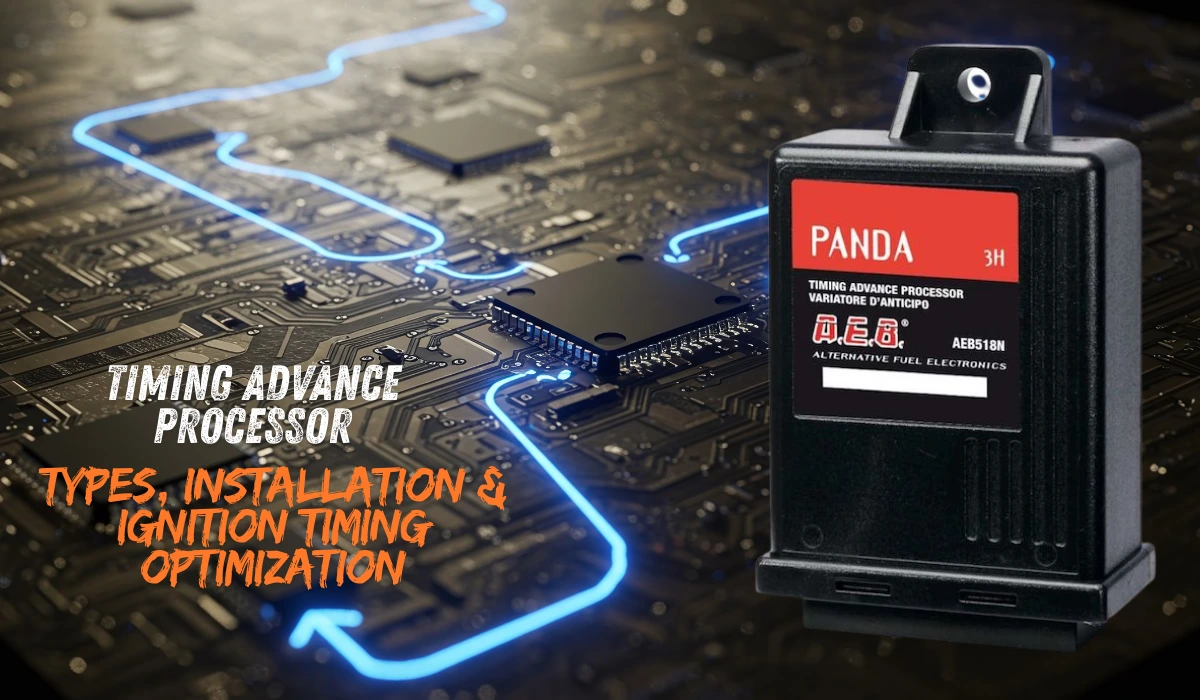
What is a Timing Advance Processor?
A timing advance processor is an electronic control unit that modifies the original spark advance timing of an engine, particularly when operating on alternative fuels such as CNG (Compressed Natural Gas) or LPG (Liquefied Petroleum Gas). This specialized device intercepts ignition timing signals and advances them by 5-20 degrees relative to crankshaft position to optimize combustion for these alternative fuels.
Unlike traditional ignition timing modifications that alter sensor signals, modern timing advance processors operate at the output stage—intercepting signals sent to ignition coils rather than modifying sensor inputs. This architectural difference preserves the integrity of the ECU’s self-diagnostic systems and variable valve timing coordination, allowing the engine to function optimally without triggering error codes.
The primary purpose of a timing advance processor is to compensate for the slower burn rate of alternative fuels compared to gasoline. By advancing the ignition timing—meaning the spark plug fires earlier in the combustion cycle—these devices allow more complete combustion, potentially increasing power and efficiency. Additionally, they help maintain the optimum operating point of the ignition coil when switching from conventional gas to alternative fuel.
Most timing advance processors include several key features:
- ): Ability to select specific degrees of spark advance
- ): Options to exclude spark advance when idling
- ): Automatic reset to original spark advance when running on petrol
- ): Emergency connectors that bypass the processor if malfunctions occur
The internal operation involves sophisticated real-time signal processing. The processor analyzes the ignition signal from the ECU, identifies the precise moment of ignition, and calculates the necessary delay to achieve the desired advance. This process requires microsecond-level accuracy—at 6,000 RPM, each crankshaft degree represents approximately 27 microseconds.
Some advanced models are designed to interface with the vehicle’s original connectors, eliminating the need to modify the vehicle’s original electrical system. Furthermore, these devices can reduce consumption and minimize the risk of backfiring in engines running on alternative fuels.
While automotive applications are most common, timing advance processors also exist in telecommunications contexts, where they help manage signal timing between mobile devices and network towers. However, the automotive application remains the primary use case, where these devices serve as crucial components for optimizing performance in alternative fuel conversions.
Why is Timing Advance Important in Ignition Systems?
Timing advance serves as a critical parameter in internal combustion engines, controlling precisely when the spark plug ignites the air-fuel mixture relative to piston position. Setting the correct ignition timing is crucial for optimal engine performance, as improper timing frequently causes excessive vibrations and potential engine damage.
The fundamental principle behind timing advance lies in combustion physics. Since fuel requires time to burn completely, igniting the mixture before the piston reaches Top Dead Center (TDC) allows combustion to fully develop as the piston begins its power stroke. Essentially, timing advance compensates for ignition delay—the period needed to fully ignite the mixture with a spark plug—which typically ranges from 15-35 degrees before TDC depending on engine speed.
Engine performance depends significantly on timing advance settings. Maximum power and torque typically occur around 31 degrees before TDC. Studies demonstrate that power increases with spark advance between 17° and 35° before TDC. Properly timed ignition ensures peak cylinder pressure occurs approximately 2 degrees after TDC, maximizing energy conversion efficiency.
Incorrect timing produces notable negative effects. Excessively advanced timing causes the rapidly combusting mixture to push against the rising piston during compression, resulting in knocking (pinking or pinging) and potential engine damage. Conversely, overly retarded timing allows the piston to descend too far before maximum pressure develops, leading to power loss, overheating, increased emissions, and unburned fuel.
Engine operating conditions necessitate dynamic timing adjustments. As RPM increases, timing must advance progressively since the piston moves faster while fuel continues burning at the same rate. Similarly, load conditions affect timing requirements—under high load, fuel mixtures burn more quickly, requiring less advance. For each 1,000 RPM increase, a typical engine demands approximately 1 to 1.5 degrees of additional timing advance.
Different fuels require specific timing adjustments. High-octane fuels need more advance due to slower flame speeds. Conversely, forced induction systems require less advance because of faster flame propagation. Alternative fuels like alcohol may need greater timing advance when running rich mixtures despite having faster base flame speeds.
Modern timing advance processors optimize these complex relationships automatically, adjusting timing based on multiple variables including RPM, load, temperature, and fuel type. This precise control yields significant benefits: improved power output, enhanced fuel economy, more complete combustion, reduced emissions, and lower exhaust temperatures when correctly calibrated.
Types of Timing Advance Processors
Timing advance processors are categorized based on the ignition systems they’re designed to work with and their programming capabilities. Each type serves specific vehicle configurations and offers distinct features for optimizing ignition timing.
Mechanical TAPs
Mechanical timing advance processors are designed specifically for older vehicles equipped with breaker point ignition systems that utilize mechanical timing adjustments. These systems depend on the combination of breaker points and a distributor for timing control. The AEB531 model exemplifies this category, installed between the distributor and the coil to intercept the low-voltage null signal traveling from the breaker points back to the coil. These processors compensate for the limitations of mechanical systems by providing electronic control over timing parameters.
Electronic TAPs
Electronic timing advance processors interface with modern electronic ignition systems. These processors are further subdivided based on the specific electronic ignition configuration:
- ): Coil and Distributor Systems: Models like AEB526N and AEB549N connect to electronic ignition systems that maintain a distributor but replace mechanical contacts with electronic switching. These units typically offer advance adjustment ranges of 0-20°.
- ): Inductive Sensor Systems: Processors such as AEB510N and AEB516N work with injection-ignition systems utilizing inductive-type crankshaft position sensors, providing advance ranges up to 30°.
- ): Hall Effect Sensor Systems: Models including AEB511N, AEB518N, and “Spider” are designed for vehicles with Hall effect type PMS (Position Management System) sensors. The Spider model can manage signals from two Hall sensors simultaneously (crankshaft and camshaft position).
Most electronic TAPs feature multiple preset advance curves (typically 6°, 9°, 12°, and 15°) and can automatically disable advance during deceleration.
Programmable TAPs
Programmable timing advance processors offer enhanced flexibility through adjustable parameters. These units feature multiple advance curves that can be selected via microswitches. Advanced models like “Panda” can process signals from multiple sensors simultaneously while generating engine revolution signals (0-12V) that can be input to gas control units. Their programmable nature allows users to adjust timing advance based on specific engine requirements rather than being limited to preset values.
Reprogrammable TAPs
Reprogrammable timing advance processors represent the most advanced category, allowing complete customization through computer interfaces. The AEB515N exemplifies this type, featuring firmware updating capabilities through dedicated software and connection kits. These units can be reprogrammed to adapt to different vehicle models beyond their original configuration Re. programmable TAPs typically work with sophisticated electronic ignition systems that use ignition modules for timing control. The reprogramming process involves downloading updated software that optimizes the processor for specific engine types and alternative fuel requirements, offering the highest degree of customization.
How to Install and Set Up a Timing Advance Processor
Installing a timing advance processor requires careful attention to your vehicle’s specific ignition system. Proper installation ensures optimal performance gains without risking engine damage.
Check ignition system type
Initially, determine whether your vehicle has a mechanical or electronic ignition system. Mechanical systems use breaker points and a distributor, whereas electronic systems may include a distributor with ignition module, or dual coil/individual coil arrangements. For electronic systems, identify whether your crankshaft position sensor is inductive or Hall effect type, as this determines compatibility with specific TAP models.
Select compatible TAP model
After identifying your ignition system, choose an appropriate timing advance processor. For breaker point systems, models like AEB531 are suitable. Electronic ignition systems with coil and distributor require models such as AEB526N or AEB549N. Modern vehicles with crankshaft position sensors need specific processors—AEB510N or AEB516N for inductive sensors and AEB511N, AEB518N, or 628458000 for Hall effect sensors.
Follow installation wiring diagram
Most TAPs feature plug-and-play installation designs. Connect the processor between the relevant ignition components according to your vehicle’s configuration. For distributor systems, this typically means interrupting the wire running from breaker points to the ignition coil. In sensor-based systems, the TAP connects between the crankshaft sensor and ECU. Always refer to the specific wiring diagram provided with your TAP model.
Adjust timing settings
Configure your TAP settings based on fuel type. LPG typically requires 9° more advance than original timing, while CNG needs approximately 12° additional advance. Many electronic TAPs feature microswitches to set the number of cylinders and desired advance degree (commonly between 5° and 15°).
Verify with timing light
Finally, confirmation with a timing light ensures proper installation. Connect the timing light’s positive and negative leads to the battery terminals and attach the inductive pickup to the number one cylinder spark plug wire. Start the engine and point the timing light at the timing marks on the harmonic balancer. Compare the reading against your target advance setting and make necessary adjustments by rotating the distributor or fine-tuning the TAP settings.
Common Issues and Troubleshooting Tips
Timing advance processors occasionally experience operational issues that require systematic troubleshooting approaches. Identifying these problems promptly helps maintain optimal engine performance.
Incorrect signal detection
Timing advance processors may fail to properly detect input signals from engine sensors. This manifests through symptoms like engine non-responsiveness or failure to start. To diagnose this issue, utilize an oscilloscope with dual channels to simultaneously monitor input and output signals. Verify that the charging time does not exceed 80% of the total signal period for models like AEB526N. Red LED indicators on most processors illuminate during proper gas-mode operation; an unlit LED suggests signal detection failure.
Sensor compatibility problems
Many compatibility issues arise from improper matching between timing advance processors and vehicle sensors. For engines with variable valve timing, specialized models like AEB516N, AEB518N or 628458000 are necessary. The camshaft sensor connection becomes mandatory only when using Hall Effect type sensors or when the ECU triggers fault codes related to cam-crank synchronization. Emergency connectors provided with quality TAPs allow bypassing the processor entirely if compatibility issues arise.
Over-advancing or retarding timing
Excessive timing advance produces distinctive pinging sounds—described as someone hitting the engine block with a tack hammer—when detonation occurs before the piston reaches top dead center. Conversely, insufficient timing results in sluggish performance and poor acceleration. In mechanical systems, worn distributor gears or timing chains create erratic timing at specific RPMs while showing steady timing elsewhere. The solution typically involves reducing advanced settings for engine knock or increasing them for acceleration problems.
Software configuration errors
Configuration errors commonly involve incorrect idle settings, causing rough idling. For processors with adjustable thresholds like the AEB models, improper trimmer adjustments affect TPS (Throttle Position Sensor) signal interpretation. Some processors offer selectable advance thresholds through microswitches (typically 6°, 9°, 12°, and 15°) which, when improperly set, cause performance issues. Although modern TAPs feature emergency bypass mechanisms, software errors may require complete reprogramming in some cases.
Best Practices for Using Timing Advance Processors
Effective usage of timing advance processors requires adherence to specific operational guidelines. When selecting a timing advance processor, consider vehicle compatibility first—ensure the processor functions with your specific engine model. Subsequently, examine the processor’s adjustability features, as some offer manual fine-tuning while others provide fixed settings.
For optimal performance, fuel-specific timing advance settings are crucial. Generally, LPG applications benefit from 9° more advance than the original timing, whereas CNG applications typically require 12° additional degrees. Moreover, many quality processors include options to disable advance during idling and automatically reset to original values when switching back to petrol.
Operational verification remains essential throughout the processor’s lifespan. Employ a timing-gun to check the original ignition timing before making adjustments. Afterward, manually rotate the distributor to advance timing appropriately for your alternative fuel system. Upon switching back to gasoline mode, adjust the trimmer to restore original timing values.
For technical verification, utilize an oscilloscope with dual channels—one monitoring input signals and another tracking output signals. This approach enables precise measurement of signal integrity and proper timing adjustments.
Nonetheless, maintain access to emergency connectors, which bypass the timing advance processor if system failures occur. This failsafe feature ensures continued vehicle operation regardless of processor status, providing essential protection against potential operational issues.