

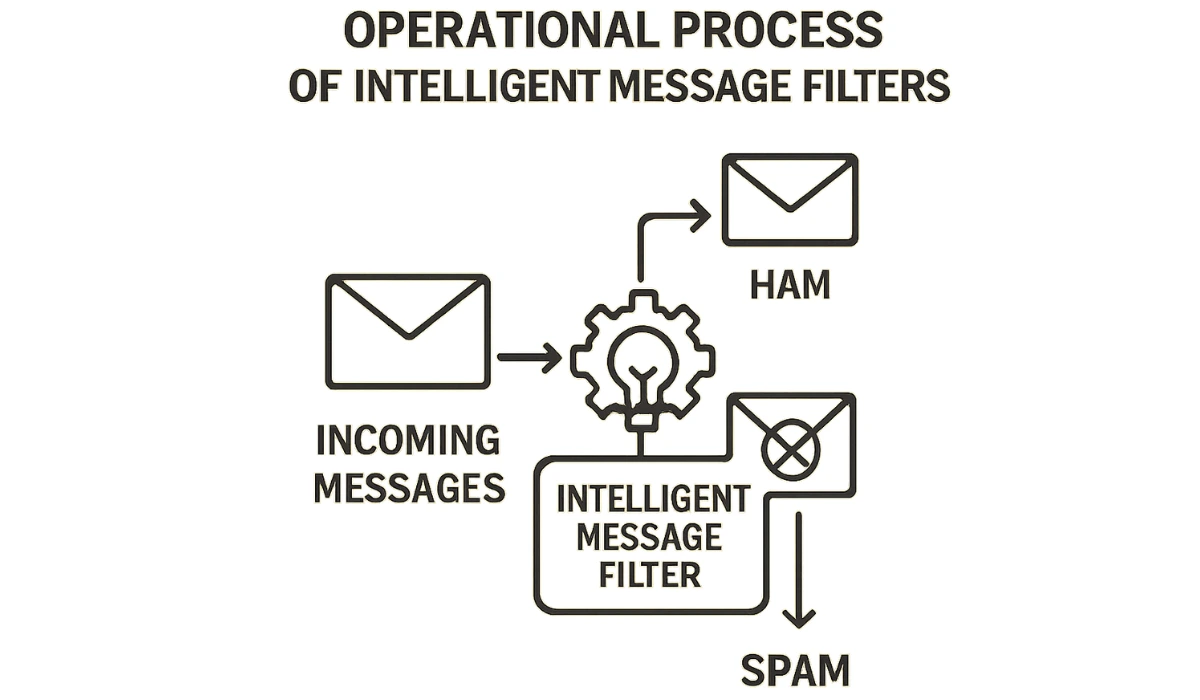
In today’s digital age, email remains a vital communication tool. However, the influx of spam can hinder its effectiveness. Intelligent message filters offer a solution to this problem.
These filters use advanced algorithms to identify and block unwanted emails. They enhance communication by ensuring only relevant messages reach your inbox.
The concept of intelligent message filters isn’t new. Exchange 2003 was among the first to implement this technology. It set a standard for future email systems.
Intelligent message filters are more than just spam blockers. They improve email security by preventing phishing and malware attacks. This makes them an essential part of any email management strategy.
Businesses benefit from these filters by saving time and reducing costs. They eliminate the need for manual email sorting. This allows employees to focus on important tasks.
Customization is another key feature. Filters can be tailored to meet specific organizational needs. This flexibility makes them suitable for businesses of all sizes.
As email threats evolve, so do intelligent message filters. Regular updates ensure they remain effective against new spam tactics.
Incorporating intelligent message filters into your communication strategy is crucial. They enhance productivity and protect your digital environment.
Understanding Intelligent Message Filters
Intelligent message filters play a critical role in modern email management. They deploy sophisticated algorithms to distinguish between genuine and unwanted messages. By doing so, they significantly improve email efficiency and security.
These filters operate by analyzing the content of incoming emails. This analysis includes looking at common spam indicators, sender reputation, and other patterns. Once these factors are evaluated, the filter assigns a spam score to each email.
Understanding the capabilities of these filters is vital for organizations. Some key functions include:
- ): Content Analysis: Inspecting email content for suspicious elements.
- ): Sender Verification: Checking sender reputation to prevent spam.
- ): Behavioral Patterns: Learning from past emails to enhance accuracy.
These intelligent filters don’t work in isolation; they are part of a broader security strategy. They can be combined with other tools like anti-virus software to provide a multi-layered defense.
To visualize this concept, imagine a digital gatekeeper for your inbox.

By intelligently filtering messages, these systems not only reduce inbox clutter but also protect sensitive information from threats. This makes them indispensable for secure and efficient email communication.
How Intelligent Message Filters Work
Intelligent message filters harness advanced technology to secure email communication. They employ algorithms designed to detect unwanted messages, maintaining inbox clarity. But how exactly do they work?
Initially, these filters evaluate email headers, scrutinizing sender details and routing information. This assessment often helps flag spoofed or suspicious sources effectively. The core of their power lies in content analysis. Filters parse email bodies using natural language processing to identify spam triggers or malicious content.
Filters also analyze embedded links and attachments. They check for known malware, ensuring your system’s safety. Behavior-based analysis is another crucial aspect. These systems learn from previous data, adapting to new patterns of spam and phishing tactics.
Key operations of intelligent message filters include:
- ): Header Analysis: Looking for anomalies in sender information.
- ): Content Parsing: Evaluating body text with language processing.
- ): Link Inspection: Checking URLs for malware presence.
- ): Behavior Learning: Evolving with new data patterns.
Enhanced by machine learning, these filters improve over time, adapting to emerging threats. This proactive approach minimizes the risk of harmful emails reaching user inboxes.
A comprehensive visual can help understand this:
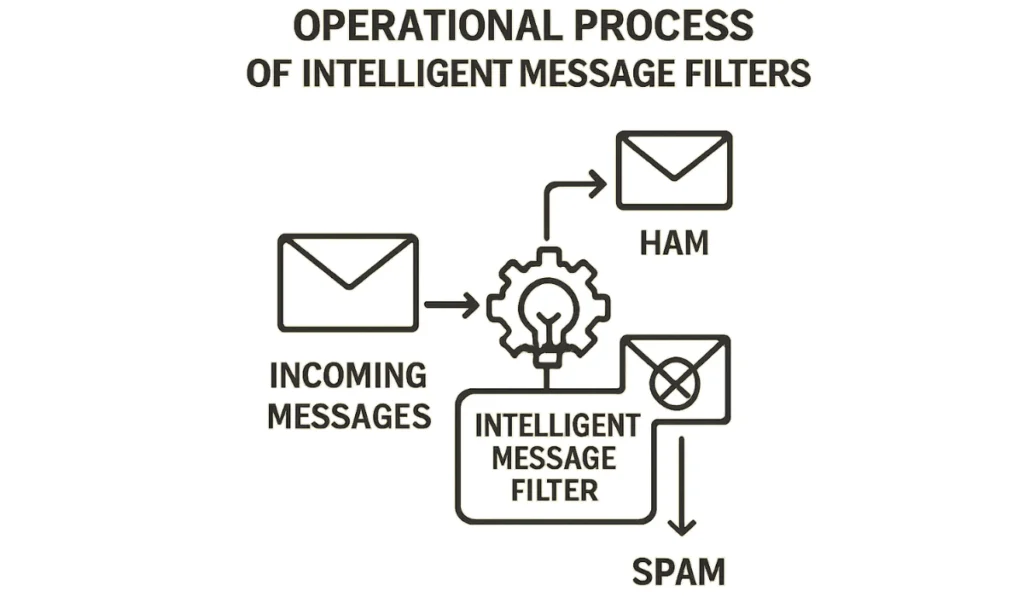
Through constant learning and adapting, intelligent message filters maintain a high level of accuracy. They not only ward off dangers but also optimize email communication by significantly reducing spam. Thus, they form an integral component of modern cybersecurity infrastructures.
Key Benefits of Intelligent Message Filters
Intelligent message filters offer numerous advantages that greatly enhance email communication. By reducing spam, they allow users to focus on what truly matters. This eliminates distractions, promoting productivity.
Beyond spam reduction, these filters strengthen email security. They block phishing attempts and malware, safeguarding sensitive data from cyber threats. Such security measures are essential in protecting organizational integrity.
Moreover, these filters can be customized to fit specific needs. Organizations can set unique rules to align with internal communication policies. This flexibility ensures that the email filtering solution suits the distinct requirements of any business size or type.
Financially, intelligent message filters lead to cost savings. By automating spam management, businesses require less manual intervention, reducing resource consumption. Over time, this translates into significant savings.
Here are some notable benefits:
- ): Spam Reduction: Reduces inbox clutter significantly.
- ): Enhanced Security: Protects against phishing and malware.
- ): Customizability: Adapts to individual organizational needs.
- ): Cost Efficiency: Cuts down manual email management expenses.
- ): Productivity Boost: Employees focus on essential tasks.

The adoption of intelligent message filters is a strategic move. It ensures not just protection but also efficiency in digital communication management. By facilitating clean and secure email environments, these filters are indispensable in modern enterprise frameworks.
Exchange 2003 Intelligent Message Filter: A Historical Perspective
The Exchange 2003 intelligent message filter marked a pivotal moment in email management. It was an early adopter of intelligent filtering technology, setting a standard for subsequent innovations. This initiative significantly enhanced the handling of spam and unwanted emails.
Exchange 2003 was equipped with a mechanism that incorporated smart algorithms. These algorithms utilized data analysis to determine which emails were likely to be spam. This approach reduced the burden on email servers and users alike. It illustrated the tangible benefits of early artificial intelligence applications in digital communication.
The implementation of this filter within Exchange 2003 provided significant insights. Organizations began to recognize the importance of automated email management systems. As a result, the tool was seen as a benchmark for similar technologies introduced later.
Key aspects of Exchange 2003’s intelligent message filter included:
- ): Algorithm-Based Filtering: Used sophisticated logic to evaluate emails.
- ): Advanced Data Analysis: Employed data patterns to detect spam.
- ): Enhanced User Experience: Offered a cleaner inbox interface.
Overall, Exchange 2003’s introduction of an intelligent message filter established Microsoft as a leader in email management. It was a decisive step towards modern email filtering solutions that businesses rely on today. The impact of this technology continues to be felt, influencing how current systems are designed and managed.
Core Features and Capabilities
Intelligent message filters boast advanced features designed to streamline email management. These features enhance efficiency and security significantly. As a result, businesses enjoy improved communication and protection.
One of the core features is spam recognition. Intelligent filters analyze content and sender history to identify potential threats. This dramatically reduces the spam that reaches users’ inboxes.
Such filters also provide sender reputation scores. This metric helps determine the trustworthiness of email sources. It provides an additional layer of scrutiny against phishing attacks.
Furthermore, intelligent message filters are customizable. Users can tailor filter settings to match specific organizational needs. This flexibility ensures that the solution meets business-specific requirements.
Key capabilities often include:
- ): Content Analysis: Scans email content for keywords and patterns.
- ): Reputation Monitoring: Evaluates sender credibility.
- ): Automated Learning: Continuously updates to recognize new threats.
- ): User Reporting: Allows user feedback to enhance accuracy.
These capabilities make intelligent message filters indispensable for modern businesses. They offer a tailored, robust solution that adapts to diverse communication demands. The result is a cleaner, safer email environment conducive to productivity.
Implementation and Configuration Best Practices
Successfully implementing intelligent message filters requires careful planning. Proper configuration is crucial to maximize their effectiveness. Consider these best practices to ensure optimal performance.
Begin with a clear assessment of your organization’s needs. Identify key threats and tailor the filter settings accordingly. Customization allows a focus on potential risks specific to your environment.
Regularly update the filter software to counter new spam tactics. Email threats evolve rapidly, so staying updated is essential. Automating updates can streamline this process and prevent lapses.
Involve users through feedback mechanisms. Users can report false positives or missed spam, refining the system’s accuracy. This feedback loop enhances the filter’s learning and adaptability.
Integration with existing security measures is vital. Use intelligent message filters alongside other defenses for robust protection. A multi-layered strategy improves overall security against various threats.
Use detailed analytics to monitor filter performance. Track metrics like spam detection rates and user feedback trends. These insights can guide further customization and tuning efforts.
Best practices include:
- ): Conducting regular needs assessments.
- ): Updating filter software consistently.
- ): Encouraging user feedback.
- ): Integrating with other security tools.
- ): Analyzing performance data.

Following these practices can significantly enhance your email filtering solution. Proper implementation leads to a safer, more efficient communication environment. In turn, productivity and security are markedly improved.
Intelligent Message Filters vs. Traditional Email Filtering Solutions
Intelligent message filters have revolutionized the way we manage emails. Traditional filters, however, still find widespread use. Understanding their differences is key to choosing the best option.
Traditional email filtering solutions rely on predefined rules and blacklists. They can block known threats but may miss new spam tactics. This approach works best for stable, predictable email threats.
In contrast, intelligent message filters use advanced algorithms and machine learning. They adapt to emerging threats and can predictively identify spam. This dynamic approach offers greater accuracy and fewer false positives.
Despite the benefits, intelligent filters may require more resources. They often involve upfront configuration and ongoing tuning. Yet, the added security and efficiency can justify these efforts.
Key differences include:
- ): Traditional filters use static rules.
- ): Intelligent filters adapt through machine learning.
- ): Traditional methods are simpler but less flexible.
- ): Intelligent filters may demand more initial setup.
Organizations should assess their needs and resources before deciding. Intelligent filters are ideal for those prioritizing cutting-edge security and adaptability. Traditional solutions may suit simpler or budget-conscious needs.
Customization and Scalability for Modern Organizations
Modern organizations require flexibility in their email management systems. Intelligent message filters offer this through robust customization and scalability. This ensures they fit diverse business needs.
Customization is a vital feature of intelligent filters. These filters can adapt to specific organizational requirements. Users can set rules, create exceptions, and tailor filters to target specific threats. This level of control enhances security and efficiency.
Scalability allows these filters to grow alongside organizations. As businesses expand, so too can their email filtering solutions. Intelligent filters can handle increased email volume and complexity without sacrificing performance. This ensures continuous protection.
Key capabilities include:
- ): Rule-based customization
- ): Performance scaling with business growth
- ): Adaptability for diverse organizational needs
- ): Integration with existing systems
Both customization and scalability are crucial for maintaining effective communication. They ensure that email filtering solutions evolve with organizational demands. By embracing these features, businesses can enhance their communication infrastructure and security measures effectively.
Challenges and Limitations
Even advanced systems face challenges. Intelligent message filters are no exception. Despite their sophistication, they have limitations that users should consider.
One significant limitation is their potential to misclassify emails. While algorithms learn over time, false positives remain a concern. Legitimate emails might be wrongly labeled as spam, disrupting communication.
Integration with existing systems might pose challenges. Some organizations find it difficult to incorporate new filters seamlessly. This can lead to compatibility issues and require additional resources.
Common challenges include:
- ): Risk of false positives
- ): Integration difficulties
- ): Maintenance and updates
- ): Complexity for non-technical users
Addressing these limitations requires ongoing attention and resources. Regular updates and user training can mitigate many issues. Nevertheless, organizations must weigh these challenges against the benefits to make informed decisions.
Future Trends in Intelligent Message Filtering
The landscape of intelligent message filtering is evolving rapidly. Emerging trends focus on enhanced accuracy and seamless integration. As technology advances, so do the features of these filters.
Artificial intelligence and machine learning are at the forefront. These technologies promise more effective spam detection. They will lead to smarter filters that adapt to new threats faster.
Future developments may include:
- ): Improved AI-driven accuracy
- ): Real-time threat detection
- ): Enhanced user interfaces
- ): Increased focus on data privacy
These advancements will enhance email security and communication efficiency. Organizations can look forward to more robust solutions. Staying informed about these trends is crucial for effective email management.
Conclusion: The Essential Role of Intelligent Message Filters in Communication
Intelligent message filters have become indispensable in modern communication. They offer a robust solution to combat unwanted and malicious emails. Their role in maintaining secure and efficient email systems is crucial.
By minimizing spam and potential threats, these filters enhance productivity. Employees can focus on essential tasks without distractions. This streamlined approach ensures vital communications receive the attention they deserve.
The future of email management looks promising with intelligent message filters at the helm. Organizations that adopt these tools gain a significant advantage. Ultimately, they create a safer and more efficient digital environment.