

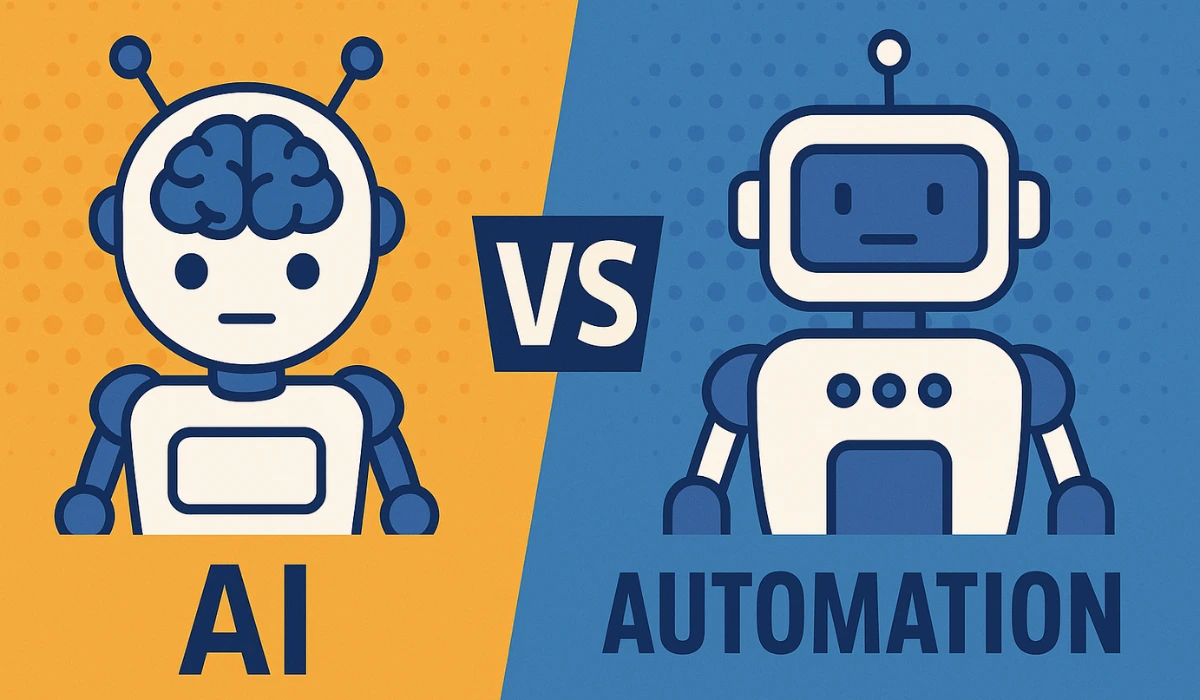
Hey there, digital trailblazer! If you’ve ever stared at your overflowing inbox wondering if a bot could handle it—or dreamed of an AI sidekick predicting your next move—you’re not alone. In 2025, the lines between AI and automation blur faster than a viral TikTok trend. But here’s the truth: they’re powerhouse tools that supercharge your workflows, just in different ways.
Whether you’re a marketer juggling SEO tasks or a solopreneur scaling your side hustle, understanding AI vs automation isn’t just geeky—it’s your ticket to smarter efficiency. In this guide, we’ll break it down simply, with real examples from tools like Zapier and ChatGPT-5. Let’s dive in and demystify the duo.
What Is AI? The Brain Behind Intelligent Decisions
Picture AI as that intuitive friend who doesn’t just follow recipes—they improvise based on what’s in the fridge. Artificial Intelligence mimics human smarts: it learns from data, spots patterns, and makes predictions without rigid scripts.
In 2025, AI powers everything from personalized Netflix queues to Notion AI drafting your meeting notes. According to recent stats, a whopping 83% of companies now prioritize AI in their strategies, fueling roles for 97 million people worldwide. It’s not magic; it’s algorithms crunching massive datasets to “think” on the fly.
Beginners often mistake AI for sci-fi robots, but it’s already in your pocket—think Siri evolving into ChatGPT-5, which now handles nuanced creative brainstorming with eerie accuracy. I tested it last week for a blog outline; it suggested angles I hadn’t even considered. Game-changer.
What Is Automation? The Reliable Workhorse for Repetitive Tasks
Now, flip to automation: the diligent assistant who excels at checklists. Automation uses software to execute predefined rules, handling rote jobs like clockwork. No learning curve here—it’s all about “if this, then that.”
Tools like Zapier are the MVPs, connecting apps to auto-post social updates or sync CRM data. In a world where time is money, automation frees you from the mundane, letting you focus on the big picture. But here’s a rookie pitfall: over-relying on it without tweaks leads to brittle systems that crumble when rules change.
I’ve automated my email newsletters with Zapier for years, but early on, I forgot to account for daylight savings—chaos ensued! Lesson learned: keep it simple and monitor.
AI vs Automation: Spotting the Key Differences
So, what’s the real divide in AI vs automation? Automation shines in predictability; AI thrives on variability. One’s a scriptwriter, the other’s an improv artist.
To make it crystal clear, here’s a quick comparison table:
| Aspect | Automation | AI |
| Core Function | Executes fixed rules for repetitive tasks | Learns from data, adapts, and predicts |
| Decision-Making | Rule-based (e.g., if X, do Y) | Intelligent (e.g., analyzes patterns) |
| Flexibility | Low—breaks if inputs change | High—handles unknowns via machine learning |
| Examples (2025) | Zapier zapping leads to sheets | ChatGPT-5 generating custom SEO content |
| Best For | Data entry, backups | Personalization, forecasting |
| Cost/Complexity | Lower entry barrier | Higher setup but scalable ROI |
This table isn’t just eye candy—it’s your cheat sheet for deciding when to deploy each. Pro tip: In 2025, 47% of workers use AI to enhance or automate processes, blending the two for hybrid wins.
Where AI and Automation Overlap: The Power Duo
Don’t pit AI vs automation as enemies—they’re collaborators. Enter AI-powered automation, where AI adds brains to automation’s brawn. Think SurferSEO using AI to auto-optimize content outlines while automating keyword research.
In business, this overlap slashes errors by 30% in workflows, per industry reports. A funny aside: I once automated social posts with plain rules, but they sounded robotic. Swapping in Notion AI for tone tweaks? Now they convert like charm.
Common mistake? Treating them as silos. Integrate early—start with a simple Zapier zap triggered by AI insights from ChatGPT-5.
Real-World Use Cases: AI and Automation in Action (2025 Edition)
Let’s get practical. Here’s where AI vs automation plays out in your daily grind:
Marketing & Content Creation
- Automation: Zapier auto-publishes blog posts from RSS feeds to LinkedIn.
- AI: ChatGPT-5 crafts viral hooks based on trending topics, boosting engagement 25%.
Use both: Automate distribution of AI-generated newsletters. [Link: Our tutorial on AI content tools for beginners].
E-Commerce & Customer Service
- Automation: Chatbots routing queries via predefined flows in tools like Intercom.
- AI: Predictive analytics forecasting inventory dips, preventing stockouts. In 2025, AI cuts response times to seconds, delighting 80% more customers.
Story time: A client automated order confirmations but added AI sentiment analysis—turns out, grumpy replies were tanking reviews. Fixed overnight.
Operations & HR
- Automation: Payroll runs on schedule with QuickBooks integrations.
- AI: Resume screening via LinkedIn AI, matching skills with eerie precision. With 97 million AI jobs emerging, this duo is reshaping hiring.
Humor alert: Without AI, automation might hire based on buzzwords alone—hello, cat video expert for your dev team!
Development & Analytics
- Automation: CI/CD pipelines in GitHub Actions for code deploys.
- AI: GitHub Copilot (now supercharged in 2025) suggesting fixes that shave dev time by 19%—wait, actually, early tests showed a slowdown if over-relied on, so balance is key.
These cases show AI vs automation isn’t zero-sum; it’s about layering for exponential gains.
Pros and Cons: Weighing Your Options
No tool’s perfect—let’s balance the scales:
Automation Pros:
- Quick setup, low cost.
- Reliable for steady tasks.
- Scales without babysitting.
Automation Cons:
- Rigid; fails on edge cases.
- No innovation—it’s “dumb” execution.
AI Pros:
- Adaptive and insightful.
- Drives creativity and foresight.
- Huge ROI in dynamic fields.
AI Cons:
- Steeper learning curve and costs.
- Needs quality data (garbage in, garbage out).
- Ethical hiccups, like bias in decisions.
Mentor mode: Start small. Automate the basics, then sprinkle AI where intuition matters. You’ll avoid the overwhelm I felt jumping straight to advanced models.
FAQs: Quick Answers on AI vs Automation
What’s the main difference between AI and automation?
Automation follows rules for repeats; AI learns and adapts like a human brain.
Can I use AI and automation together in 2025?
Absolutely—AI-powered automation is booming, with 80% of firms adopting GenAI for workflows.
Which is better for small businesses: AI or automation?
Automation for starters (cheap and fast); layer AI as you grow for personalization.
How does ChatGPT-5 fit into AI vs automation?
It’s pure AI for generation, but pair it with Zapier for automated delivery.
Will AI replace automation entirely?
Nah—AI enhances it. Think evolution, not extinction.
Wrapping It Up: Choose Your Tech Allies Wisely
There you have it: AI vs automation boils down to smarts versus speed, but together? They’re unstoppable for 2025’s fast-paced digital world. Whether you’re tweaking SurferSEO with AI insights or zapping tasks via Zapier, the key is experimentation. I promise, one small tweak could save you hours weekly.
What’s your first move—automate that email chain or AI-boost your content? Drop a comment below; I’d love to brainstorm.
“Explore more smart tutorials at TheDigitalHowTo.com — where tech gets simple.”