

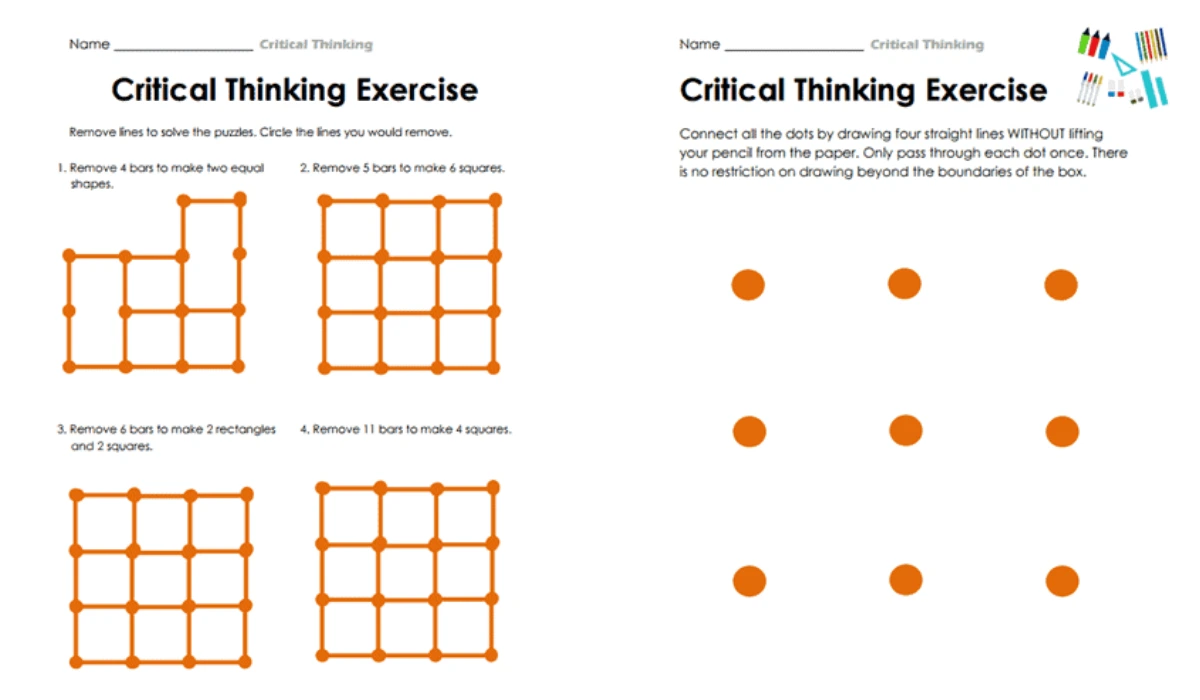
Critical thinking is analyzing information objectively to make reasoned judgments. Research shows 75% of employers prioritize these skills, yet most professionals never formally develop them. These seven exercises build analytical abilities through consistent practice.
What Is Critical Thinking?
Critical thinking combines analysis, evaluation, inference, and problem-solving. Studies confirm regular practice strengthens neural pathways in the prefrontal cortex, improving decision-making speed and accuracy.
Core skills:
- ): Breaking down complex information
- ): Evaluating source credibility
- ): Recognizing biases and assumptions
- ): Drawing logical conclusions
- ): Solving problems systematically
7 Essential Critical Thinking Exercises
1. The Ladder of Inference
This exercise reveals how you jump to conclusions.
How to use it: Work backward from any strong opinion:
- ): What conclusion did I reach?
- ): What assumptions led there?
- ): How did I interpret the data?
- ): What information did I select or ignore?
- ): What actually happened?
Example: Colleague checks phone in meetings → You think they’re uncommitted. Reality: Could be a family emergency, waiting for critical info, or managing urgent issues.
Why it works: Exposes flawed reasoning before you act on it.
2. Five Whys Analysis
Toyota’s founder created this root-cause technique.
Method:
- 1. State the problem
- 2. Ask “Why?” five times
- 3. Each answer becomes the next question
- 4. Address the root cause
Example:
- ): Problem: Customer satisfaction declining
- ): Why? Slow response times
- ): Why? Longer ticket resolution
- ): Why? Team overwhelmed
- ): Why? Insufficient staff
- ): Why? Didn’t scale with growth
Root cause: Resource allocation, not performance.
3. Six Thinking Hats
Edward de Bono’s method examines problems from six perspectives.
The six hats:
- ): White: Facts and data only
- ): Red: Emotions and gut feelings
- ): Black: Risks and problems
- ): Yellow: Benefits and opportunities
- ): Green: Creative alternatives
- ): Blue: Process and next steps
Application: Spend 2-5 minutes per hat. Everyone uses the same hat simultaneously.
Proven results: IBM reduced meeting times by 75% using this method.
4. Socratic Questioning
Ancient technique using strategic questions to examine ideas.
Six question types:
- 1. Clarification: “What do you mean?”
- 2. Assumptions: “What are you assuming?”
- 3. Evidence: “What supports that?”
- 4. Perspectives: “How would others see this?”
- 5. Implications: “What follows if you’re right?”
- 6. Meta-questions: “Why is this important?”
Daily practice: Before accepting claims, ask: “What evidence supports this?”
Research: Healthcare students showed significant critical thinking improvement using Socratic methods.
5. Reverse Brainstorming
Solve problems by first imagining how to make them worse.
Process:
- 1. State your goal
- 2. Reverse it completely
- 3. List ways to achieve the worst outcome
- 4. Flip each negative into a solution
Example:
- ): Goal: Better team communication
- ): Reversed: Destroy communication
- ):: Never respond → Set response standards
- ):: Use 10 platforms → Standardize tools
- ):: Avoid meetings → Schedule regular sync
- ):: Hide information → Build shared knowledge base
6. Pre-Mortem Analysis
Assume your project failed. Identify why before it happens.
Steps:
- 1. Imagine complete failure
- 2. List all possible causes (10 minutes)
- 3. Identify most likely problems
- 4. Create preventive measures
- 5. Adjust plan
Why it works: Catches problems optimistic planning misses.
7. Assumption Testing
Make invisible assumptions visible and testable.
Framework for any decision:
- ): “I’m assuming…”
- ): “This fails if…”
- ): “I might be wrong about…”
- ): “Evidence that changes my mind…”
Example (remote work):
- ): Assuming: I’m self-disciplined enough
- ): Fails if: No accountability system
- ): Wrong about: Productivity without office
- ): Changes mind: Output drops 30+ days
Quick Start Guide
Week 1-2: Practice Ladder of Inference 10 min/day
Week 3-4: Add Socratic questioning to conversations
Month 2: Use Six Thinking Hats for important decisions
Month 3: Keep decision journal with assumption testing
Results: Stanford research found students were 12x more likely to improve data quality using these methods.
Common Mistakes
Analysis paralysis: Reserve deep thinking for high-stakes decisions only.
Confirmation bias: Actively seek contradicting evidence.
Inconsistent practice: Skills develop only through regular use.
Ignoring emotions: Acknowledge feelings before analyzing logically.
Measuring Progress
Track these indicators:
- ): Do you question claims before accepting them?
- ): Can you argue positions you disagree with?
- ): Do you catch your own assumptions?
- ): Are your decisions producing better outcomes?
Bottom Line
Critical thinking improves through practice, not talent. Start with one exercise. Practice daily for two weeks. Add another. Within 8 weeks, you’ll see measurably better judgment.
Research confirms: consistent critical thinking practice strengthens decision-making in work, health, relationships, and finances.
FAQs
How long does it take to improve critical thinking?
Most people notice improvements in 4-6 weeks with daily 10-15 minute practice. Stanford research showed students maintained gains one year later with consistent use.
Which exercise should beginners start with?
The Ladder of Inference. It’s simple, applies immediately to daily decisions, and reveals thought patterns quickly. Practice on one decision daily for two weeks.
Can I practice critical thinking alone?
Yes. Use decision journals, Ladder of Inference, Socratic self-questioning, and assumption testing solo. Six Thinking Hats works best in groups. Combine both for best results.
Does critical thinking reduce creativity?
No, it enhances creativity. Green Hat and reverse brainstorming explicitly generate creative ideas. The pattern: create without judgment first, then evaluate critically.
How do I avoid overthinking decisions?
Use tiered analysis: quick thinking for small choices, moderate analysis for medium decisions, deep thinking only for major consequences. Set time limits.
What’s the fastest critical thinking improvement method?
Daily Socratic questioning. Simply ask “What evidence supports this?” before accepting any claim including your own. This single habit builds multiple skills simultaneously.
Do these exercises help with emotional decisions?
Yes. Acknowledge emotions first using Red Hat thinking, then analyze with other perspectives. The Ladder of Inference separates facts from emotional interpretations effectively.